

Places to visit · Sorrento
The Baths of Queen Giovanna in Sorrento
A natural rock pool and the remains of a Roman villa on Capo di Sorrento: how to reach the Baths of Queen Giovanna and what to know before you go.
3 min read
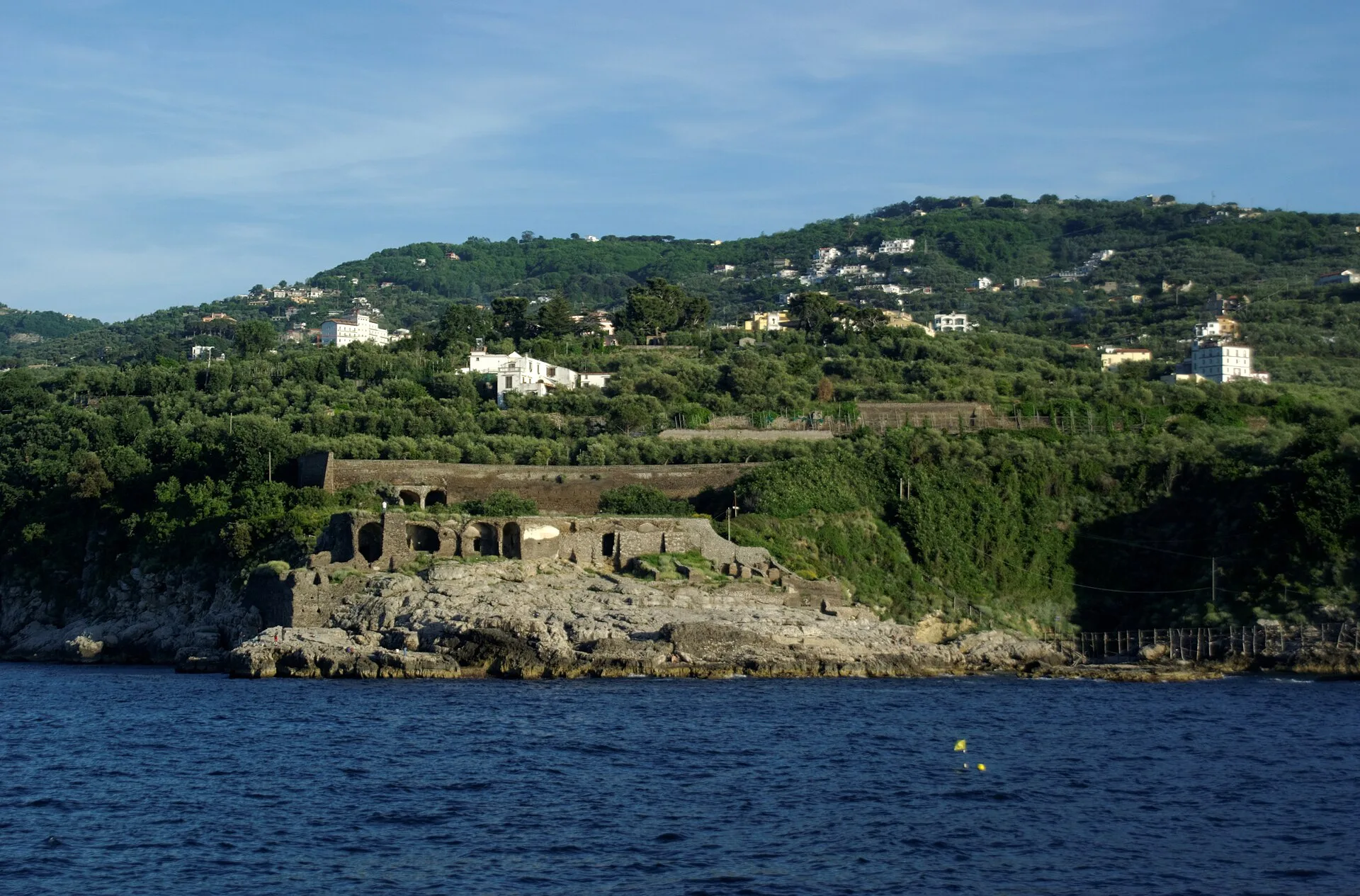
The Bagni della Regina Giovanna, or Baths of Queen Giovanna, are a natural pool of emerald water enclosed by the rocks of Capo di Sorrento and linked to the open sea by a narrow passage beneath a stone arch. Around it lie the remains of a large Roman seaside villa. They can be reached on foot in about half an hour from the centre and are one of the most evocative places on the Sorrento coast, where archaeology, legend and the sea meet.
The legend of the queen
The name comes from popular tradition, which says that Queen Giovanna II of Anjou-Durazzo (Joan II), ruler of Naples in the early 15th century, loved to come down here to bathe away from prying eyes; the more mischievous versions add that she met her lovers here. There is no document to prove it, but the legend gave the place the name everyone knows it by. For the historical background, read our history of Sorrento.
The Roman villa on the Capo
Long before the queen, this headland was occupied by a luxurious villa, one of the many retreats that wealthy Romans built around the Bay of Naples between the 1st century BC and the 1st century AD. Tradition identifies it with the villa of Pollius Felix, praised by the Latin poet Statius in his Silvae (II, 2) as one of the finest homes on the bay; some scholars, however, believe Pollius's villa stood a little further along, in the bay of Puolo.
The complex was divided into two parts: the seaside villa on the tip of the headland and a residence higher up, which also had farming functions, linked by passages and terraces. Today you can make out walls in opus reticulatum, vaulted rooms, steps cut into the rock and, above all, the small inner basin: the natural pool, perhaps used in antiquity as a sheltered landing or fish pond, which connects to the sea through an opening in the cliff.
What to see and do
- The natural pool: a sheltered, crystal-clear basin whose colours change with the light of the day.
- The villa ruins: scattered across the headland, they can be explored freely along the paths.
- The view: from the point you can take in Sorrento, Vesuvius, the Bay of Naples and, to the west, the coast leading to Punta Campanella and Capri.
- Swimming: you can swim both in the basin and off the outer rocks. There are no facilities: this is rock bathing, to be enjoyed with care.
If you prefer equipped beaches, see our guide to the beaches of Sorrento or the list of beach clubs.
How to get there
From Piazza Tasso, walk west along Corso Italia and continue on Via del Capo, the road to Massa Lubrense. After about two kilometres, at Capo di Sorrento, a gate and signs for the Roman ruins mark the start of a paved path that winds down through olive and citrus groves to the headland. On foot from the centre it takes about 30 to 40 minutes; alternatively, take one of the buses heading towards Massa Lubrense and get off at the Capo di Sorrento stop. The final path must be walked in any case.
Practical tips
- Wear comfortable shoes for the path and, for swimming, water shoes: the rocks are slippery.
- Bring water and sun protection: there is little shade on the headland and no refreshment points.
- In high summer the place is very busy: early morning and late afternoon are the quietest times, and the sunset over the bay is spectacular.
- Respect the ruins: this is an archaeological area, so do not climb on the ancient walls.
- The way back is uphill: bear this in mind if you are travelling with children or elderly people.
A day here pairs well with dinner in the village of Marina Grande, on the other side of town.
Gallery 4 photos
The Baths of Queen Giovanna in Sorrento


01 · Photo: Stéphane Gallay, CC BY 2.0 02 · Photo: Stéphane Gallay, CC BY 2.0 03 · Photo: Berthold Werner, CC BY-SA 3.0 04 · Photo: Autore sconosciuto (L'illustrazione popolare, Treves, 1885), Public domain