

Places to visit · Sorrento
Sedil Dominova in Sorrento
The nobles' loggia with its yellow and green majolica dome and 18th-century frescoes: history, details and how to reach the Sedil Dominova.
3 min read
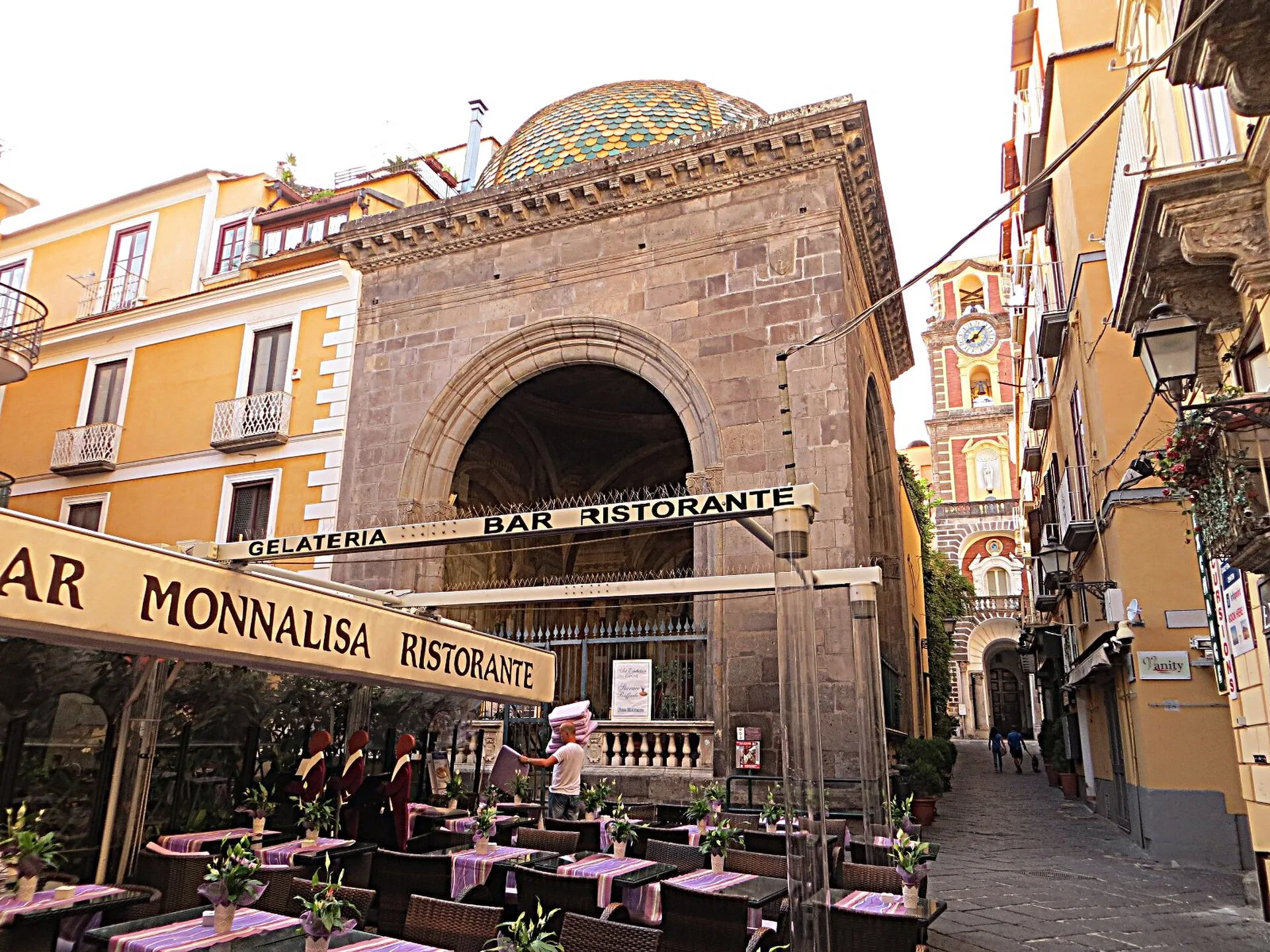
The Sedil Dominova is the Renaissance loggia, crowned by a dome of yellow and green majolica tiles, where Sorrento's nobles met for centuries. It stands on Via San Cesareo, a few minutes' walk from Piazza Tasso, and is considered the last surviving noble seat in Campania: you can admire it freely from the street, and its frescoes alone are worth a stop.
What the seats were
In the towns of the Kingdom of Naples the nobility was organised into «sedili» or «seggi» (seats): associations of families that elected representatives to the town government and had their own meeting place, often a loggia open to the street. Sorrento had two: the older Seat of Porta and the Seat of Dominova. The latter was born of a split: in 1319, after rivalries and internal quarrels, some families from the western part of town, including the Mastrogiudice, Sersale and Vulcano, left the Seat of Porta and founded a domus nova, a «new house», hence the name Dominova. The seat thus took over the patronage of the western part of Sorrento.
The architecture: piperno stone, coats of arms and majolica
The building we see today was built in the 16th century and has lost its original late-medieval forms: it is a square Renaissance loggia, open on two sides through large round arches in piperno, the grey volcanic stone typical of Neapolitan architecture, resting on columns with Byzantine-style capitals. The marble balustrade survives on the Via San Cesareo side. High up, on either side of the corner, are two 14th-century tufa coats of arms: one with the Angevin lilies crossed by the Durazzo label, the other with the civic emblem of Sorrento. A classical frieze of egg-and-dart and dentils and a projecting cornice with brackets and rosettes complete the façades.
Crowning the loggia is the dome covered in yellow and green majolica tiles laid like fish scales, attributed to the Neapolitan workshop of the Chiaiese family, renowned tile makers: it is one of the most photographed views in the old town, especially when framed together with the bell tower of the Cathedral.
The 18th-century frescoes
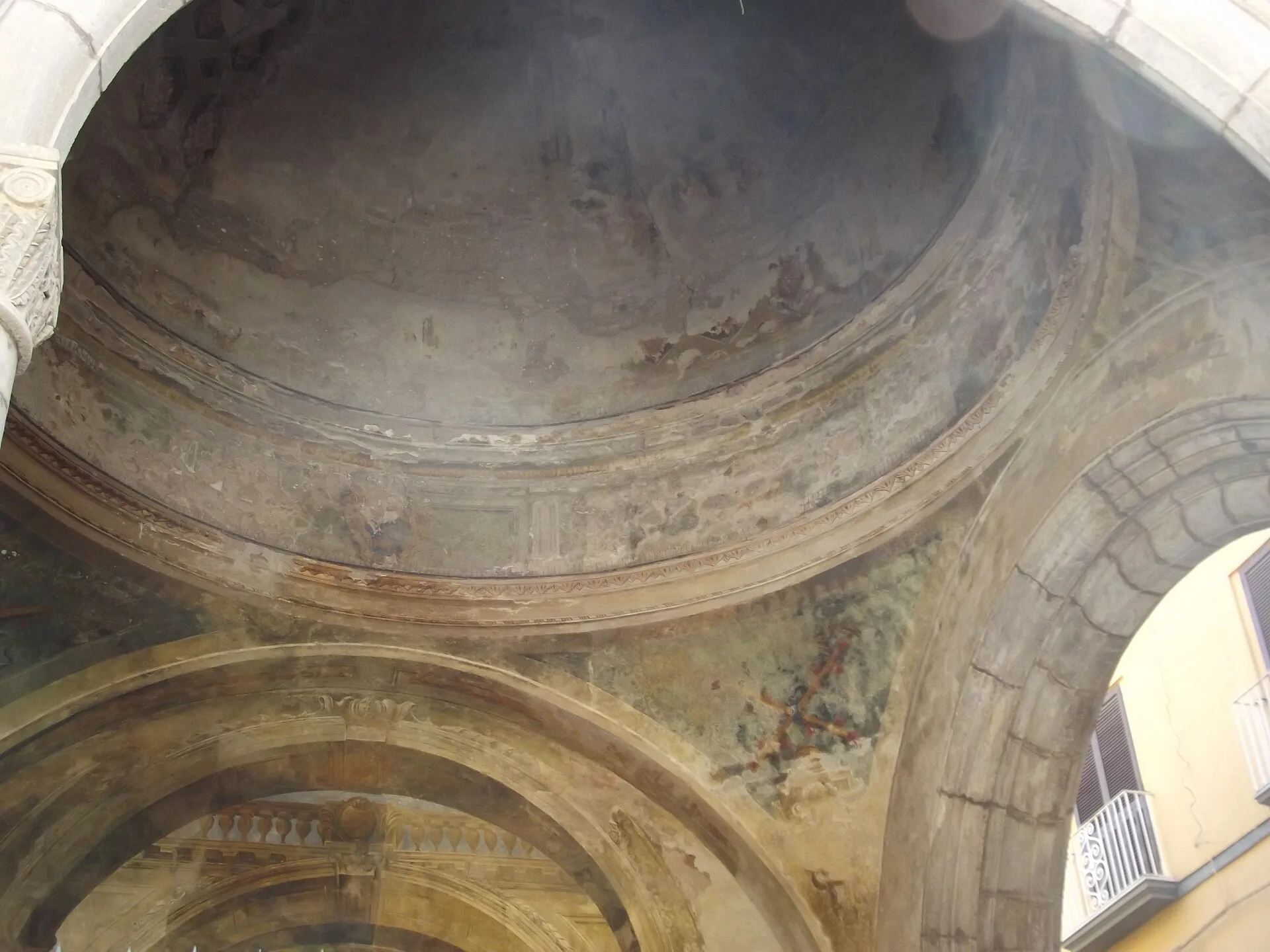
In the 18th century the interior was redecorated with frescoes attributed to the Sorrento painter Carlo Amalfi or his workshop. On the back walls, painted architecture in perspective seems to expand the space with a theatrical effect, while in the centre stands the large coat of arms of the town, held up by angels bearing a drapery; the coats of arms of the noble families belonging to the seat complete the decoration. When the seats were abolished in the Kingdom of Naples in the early 19th century, the loggia lost its political role. Since 1877 it has been the home of the Società Operaia di Mutuo Soccorso, the workers' mutual aid society, as an inscription inside recalls: a symbolic passage from nobles to workers that has kept the building alive and in use.
Getting there and visiting tips
From Piazza Tasso take Via San Cesareo, the pedestrian lane lined with shops that runs parallel to Corso Italia: after about five minutes' walk you reach the seat, at the corner with Via Padre Reginaldo Giuliani. The loggia is open to the street and the frescoes can be seen well from outside; since the interior is the seat of an association, there are no fixed visiting hours, so step in discreetly and only if access is allowed. The best light for photographing the dome is in the morning.
The seat is a natural stop on a walk through the old centre: close by are the Cathedral and Via Pietà, with its medieval palaces, and the workshops of Sorrento marquetry. To understand the world in which the seats were born, read our history of Sorrento; and if you want to eat nearby, here are restaurants and pizzerias in the centre.
Gallery 3 photos
Sedil Dominova in Sorrento
01 · Photo: Mister No, CC BY 3.0 02 · Photo: Berthold Werner, CC BY-SA 3.0 03 · Photo: Elliott Brown, CC BY 2.0