

Places to visit · Sorrento
Basilica of Sant'Antonino in Sorrento
Sorrento's patron saint's church: a crypt with his tomb, sailors' votive paintings, whale bones and Baroque canvases. What to see and tips.
4 min read
The Basilica of Sant'Antonino is the shrine of Sorrento's patron saint, and its crypt holds the remains of the abbot Antoninus, who died in 625. It stands on Piazza Sant'Antonino, a stone's throw from Piazza Tasso: it is one of the churches Sorrentines hold dearest, and in just a few metres it tells a thousand years of history, faith and seafaring life.
A saint, a tomb and a thousand years of history
Antoninus, a Benedictine monk from Campagna, came to Sorrento in the early 7th century after living as a hermit on Monte Faito with Saint Catellus, and became abbot of the monastery of Sant'Agrippino. Before he died he asked to be buried «neither inside nor outside» the town: his body was therefore laid to rest by the walls, exactly where the basilica stands today.
An oratory first grew up over the tomb and was already there in the 9th century; the church proper was built in the 11th century, reusing columns and marble from pagan temples and Roman villas along the coast. Governed first by an archpriest and then by a rector appointed by the king, from 1378 it housed the confraternity of the Battenti. In 1608 the complex passed to the Theatine Fathers, who restored and enlarged it, giving it the Baroque character we still see; when religious orders were suppressed in 1866 the fathers had to leave, and the church returned to a rector. For the wider picture, read our history of Sorrento.
What to see in the basilica
The small entrance porch already holds a surprise: large whale bones are kept here, linked to the legend of a child swallowed by a whale and returned alive through the saint's intercession. On the south side you can spot a very old little doorway framed by two columns of yellow marble with Corinthian capitals.
The interior is a Latin cross, divided into a nave and two aisles by granite columns from the Roman period. Take your time over:
- the ceiling, with gilded rosettes and 18th-century canvases by Giovanni Battista Lama, including the central one showing Saint Antoninus freeing the daughter of Sicard, Prince of Benevento, from the devil;
- the frescoed ovals along the nave, depicting the saint's miracles;
- the side chapels, dedicated among others to Saint Andrew Avellino and Saint Cajetan, the saints of the Theatine order;
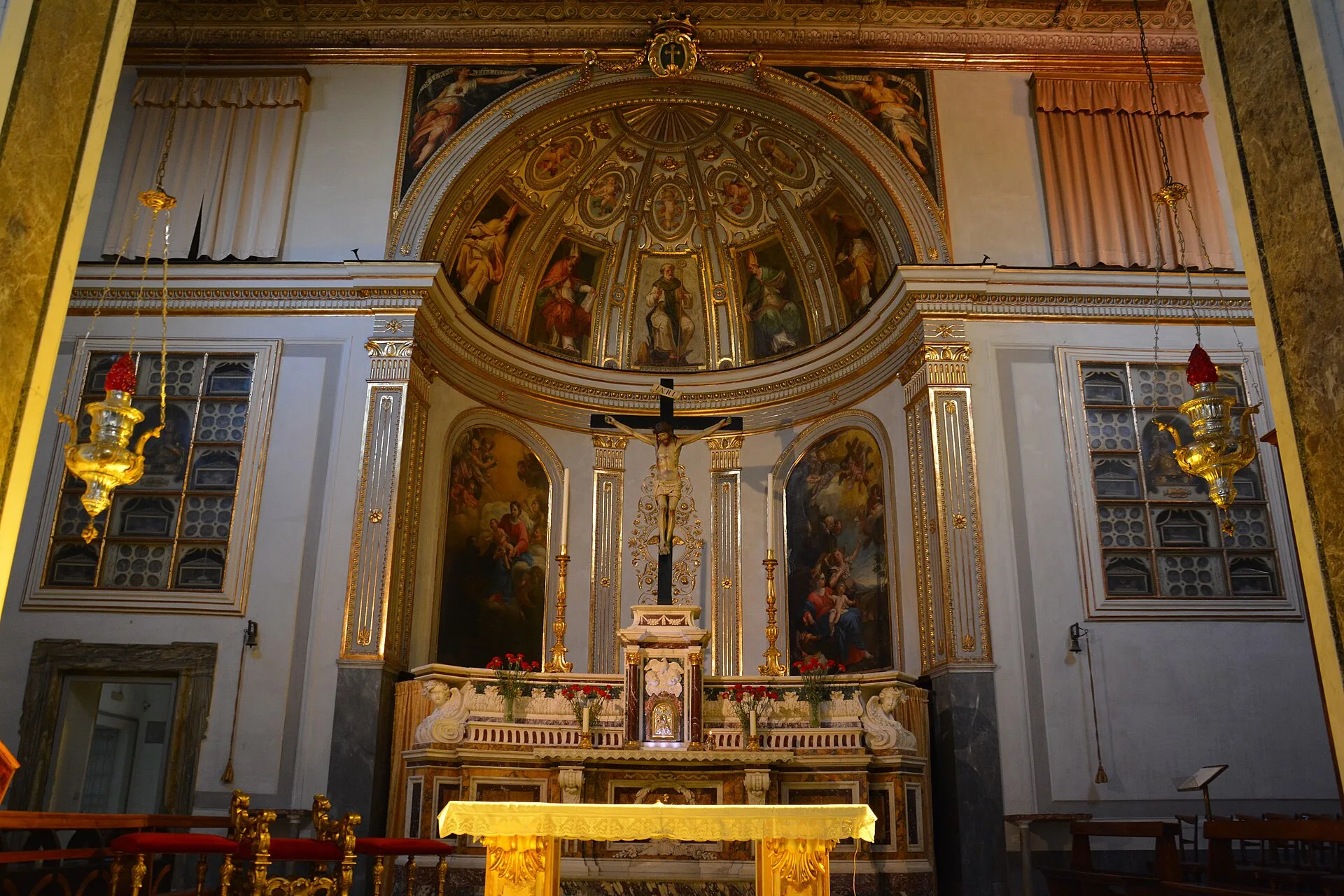
- the apse, with large canvases by Giacomo del Po, two of which recall the liberation of Sorrento from the siege of 1648 and the end of the plague of 1656;
- the silver statue of Saint Antoninus, made in 1564 and carried in procession on feast days.
The crypt and the sailors' votive offerings
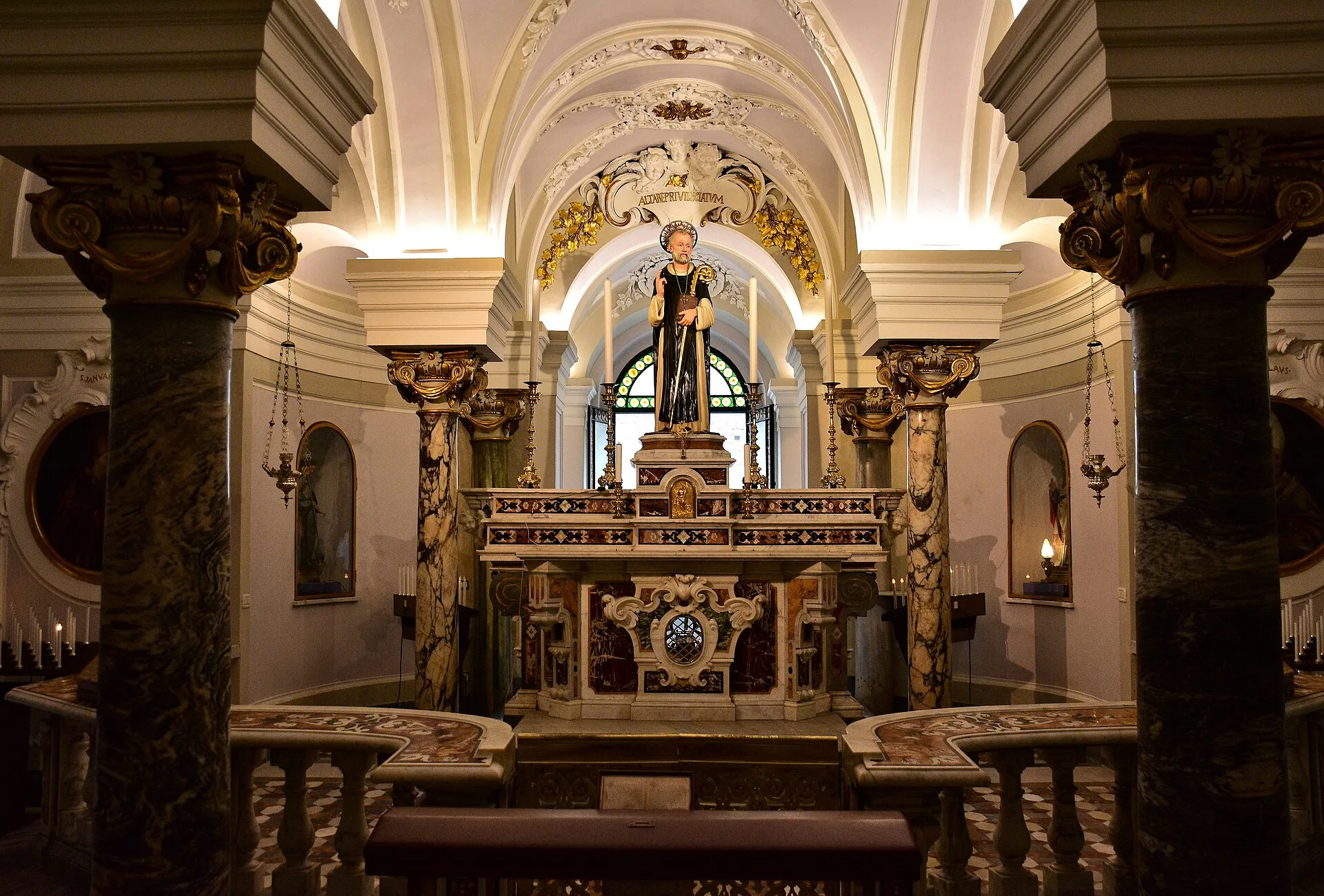
Two marble staircases at the end of the aisles lead down to the «succorpo», the crypt supported by ancient columns and decorated in the 18th century. Here, behind a balustrade, the altar holds the saint's tomb, watched over by an ever-burning silver lamp that the faithful touch as a sign of devotion. On the left is a 14th-century fresco of the Madonna delle Grazie, considered the oldest image of the Virgin in Sorrento.
The walls of the crypt and the sacristy are covered with ex-votos: small paintings of sailing ships caught in storms, offered by sailors who survived shipwreck, some signed by well-known painters such as Eduardo De Martino. The sacristy also houses a Neapolitan nativity scene with 18th- and 19th-century figures, reassembled thanks to donations from local people after a theft in 1983.
The patron saint's feast
On 14 February, the anniversary of the saint's death, Sorrento honours its patron with a procession of the silver statue through the streets of the centre, among festive lights and market stalls. It is the most heartfelt celebration of the Sorrento winter: find out more on our page about traditions and events.
Getting there and visiting tips
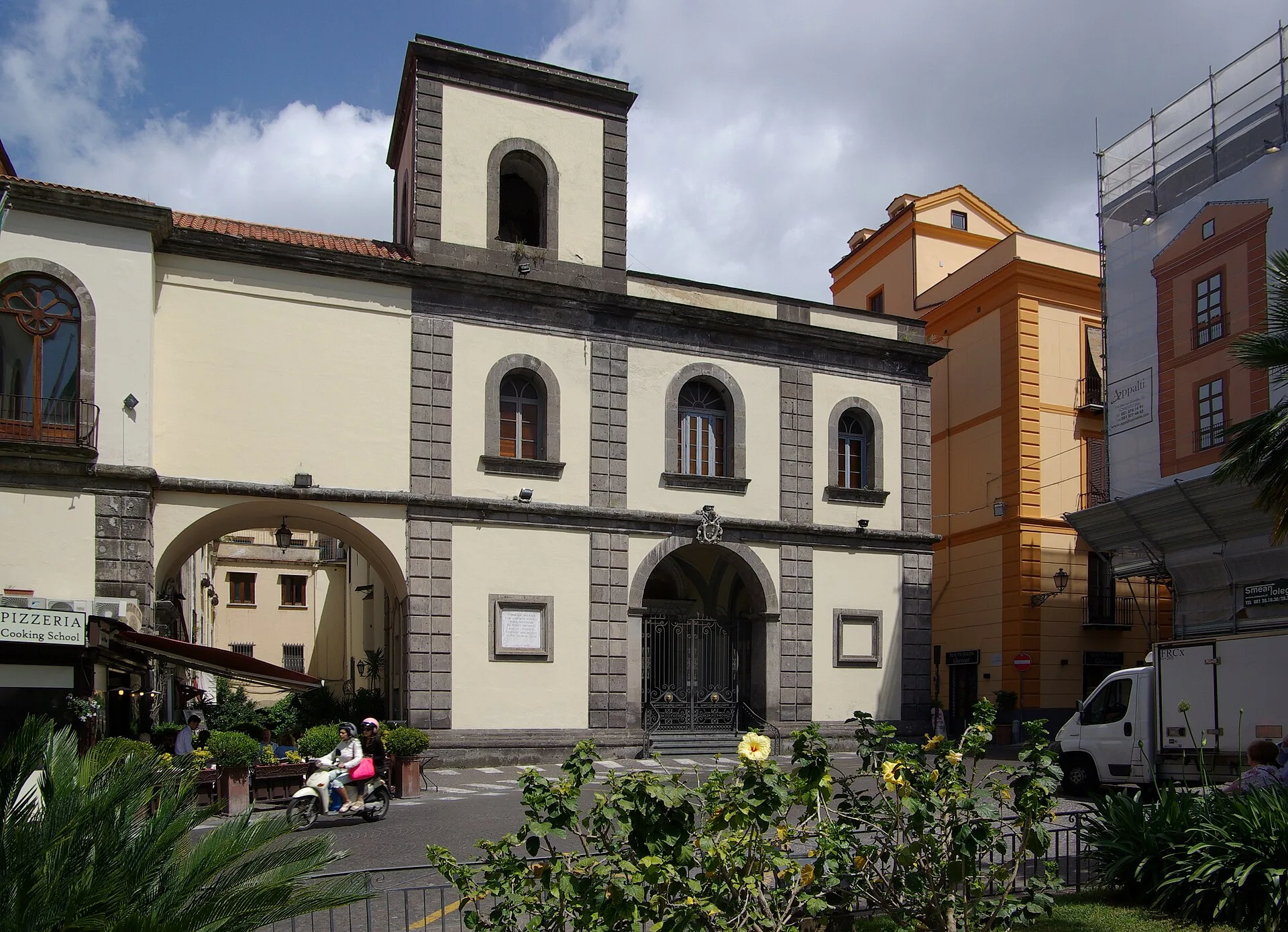
From Piazza Tasso, simply take Via Luigi De Maio: after a couple of minutes on foot you reach Piazza Sant'Antonino, with the grey tuff façade and the bell tower. The basilica is a working church: dress appropriately and keep silent during services. Carry on down Via De Maio to reach the port of Marina Piccola, while the Cathedral and the Cloister of San Francesco are just a few minutes away. For a break, there is no shortage of restaurants in the centre nearby.
Gallery 4 photos
Basilica of Sant'Antonino in Sorrento
01 · Photo: Berthold Werner, CC BY-SA 3.0 02 · Photo: MentNFG, CC BY-SA 4.0 03 · Photo: Giuseppe Guida, CC BY-SA 4.0 04 · Photo: MentNFG, CC BY-SA 4.0