

Places to visit · Sorrento
Cloister of San Francesco, Sorrento
Interlaced 14th-century arches, reused ancient columns and a quiet garden next to the Villa Comunale: the history of Sorrento's loveliest cloister.
3 min read
The Cloister of San Francesco is the most secluded and most photographed corner of central Sorrento: a small 14th-century arcaded courtyard with interlaced tuff arches and a shady garden, opening beside the church of San Francesco, a few steps from the Villa Comunale and its terrace overlooking the bay. It takes little time to visit, but it is one of the places that stay with you.
Seven centuries of Franciscan history
The cloister was built by the Franciscans in the 14th century, together with the friary and the church, on the remains of an ancient early medieval monastery. It was not only a place of prayer: in the 15th century town meetings were held here and the seal of the municipal records was kept here, a sign of the role the friars played in the life of Sorrento.
Its present appearance is the result of a long layering of styles. Between 1453 and 1470, at the wish of the father guardian and during the episcopate of Domizio Falangola, the north and west wings were renewed: the 14th-century pointed arches gave way to round arches resting on the existing octagonal pillars. The work was funded, at least in part, by the noble Sersale family, whose coat of arms appears on the capitals of the north side. After the earthquake of 1688 the porticoes were strengthened with massive walls that concealed their shapes; only with the restorations of the early 20th century did the cloister regain its lightness.
What to look out for
The cloister is rectangular, with porticoes on all four sides and a garden in the middle. Its charm lies in the details:
- the interlaced tuff arches on two sides, which cross to form elegant twin openings with lunettes: an Arab-Norman taste typical of late 14th-century Campania;
- the round arches on the other two sides, evidence of Renaissance taste coexisting with late Gothic forms;
- the columns and capitals, all different in height and decoration: some, especially at the corners, are spolia taken from ancient buildings, others bear Byzantine-style plant motifs;
- the refectory, which looks onto the cloister and retains its 14th-century structure.
With climbing plants, pots of flowers and the church bell tower rising above the roofs, the view changes with the light: early morning and late afternoon are the best times for photos.
Concerts, exhibitions and weddings
Today the cloister belongs to the town and is one of Sorrento's liveliest cultural venues, hosting classical music concerts, art exhibitions, talks and ceremonies. It is also one of the most sought-after settings for civil weddings, so you may well come across a bride and groom under the arches. During events some areas may be closed to the public: if you would like to attend a concert, ask at the tourist office or check the town council's channels. For other festive occasions, read about traditions and events in Sorrento.
Getting there and nearby sights
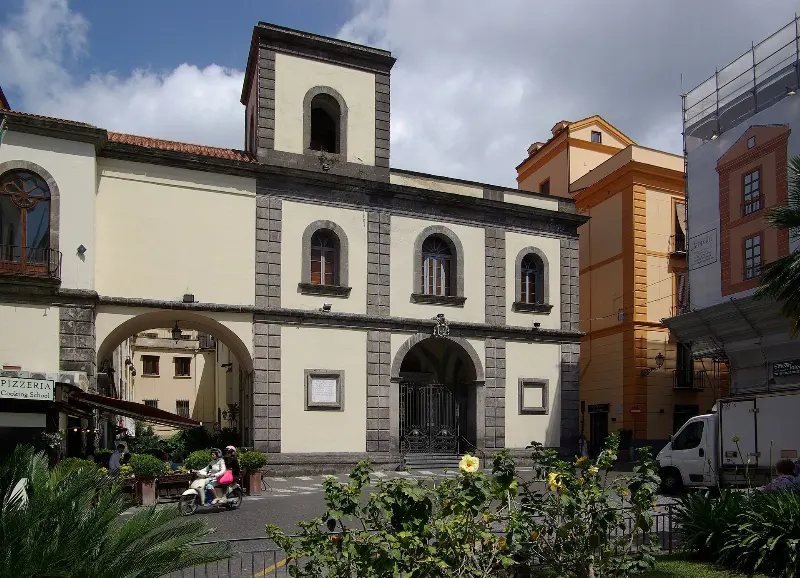
From Piazza Tasso it is about a five-minute walk along Via Vittorio Veneto to Piazza Francesco Saverio Gargiulo: the entrance to the cloister is next to the façade of the church of San Francesco. The visit pairs naturally with the Villa Comunale, overlooking the Bay of Naples and Vesuvius; from here a lift and a flight of steps lead down to the port of Marina Piccola and the bathing establishments by the sea. Nearby you will also find the Basilica of Sant'Antonino and the lanes of the old town, full of restaurants and trattorias.
Gallery 3 photos
Cloister of San Francesco, Sorrento
01 · Photo: MentNFG, CC BY-SA 4.0 02 · Photo: Berthold Werner, CC BY-SA 3.0 03 · Photo: Hajotthu, CC BY 3.0