

Suggested itineraries · Sorrento
A journey into Sorrento's past
Travel back in time: from Corso Italia and the citrus groves to medieval lanes, 16th-century walls and the remains of Roman villas.
3 min read
This itinerary tells Sorrento's story backwards: instead of starting from its origins, it begins with the town of today, with its busy main street and modern squares, and gradually goes back in time to the Middle Ages, the 16th-century walls and the Roman era. It is an original way to understand how the town built up layer by layer over the centuries, walking little more than a couple of kilometres on the flat.
1. The Agruminato
The starting point is on Corso Italia, at the Agruminato, the municipal farmland open to the public: a green lung amid the town traffic that preserves Sorrento's typical citrus groves. It is not large, but big enough to stroll among lemon and orange trees and breathe the air of the old Sorrento countryside.
2. Piazza Angelina Lauro and Corso Italia
Heading towards the centre you reach Piazza Angelina Lauro, laid out on a former farm belonging to the Lauro family, with flower beds, centuries-old trees and plenty of shops around it. On the right is a bust of Achille Lauro, a long-lived shipowner who also held important public offices and left his mark on the history of Sorrento and Naples in the 20th century. Further on, on the façade of number 186 Corso Italia, plaques commemorate distinguished guests who stayed in Sorrento, among them the historian Bartolommeo Capasso.
3. The Carmine church
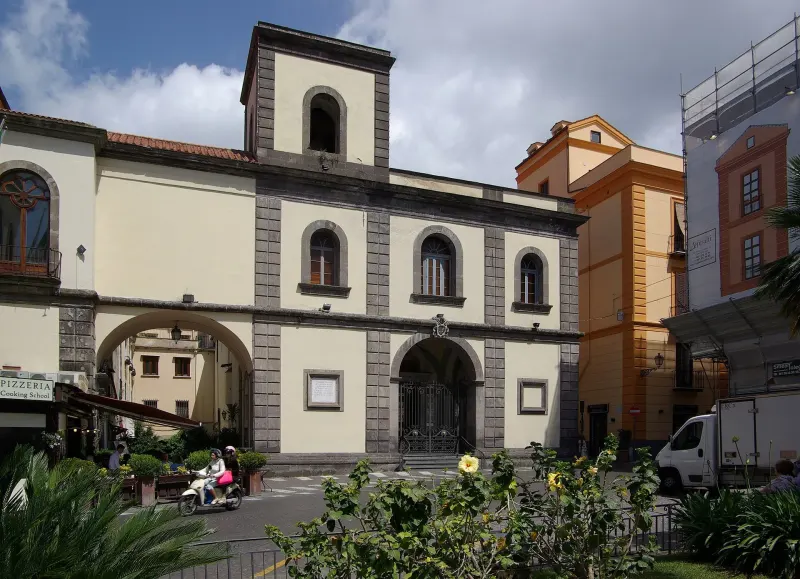
On the corner of Piazza Tasso, the Carmine church, with its yellow and white Baroque façade, is worth a short visit.
4. The Vallone dei Mulini
Crossing the main street, on the other side you reach the Vallone dei Mulini, one of the best-preserved ravines on the Sorrento peninsula: from the parapet you can see the ruins of the old mill wrapped in vegetation, a reminder of the natural gorges that defended the town for centuries.
5. Back to Piazza Tasso
Back in Piazza Tasso, walk past the flower bed with the statue of Torquato Tasso, Sorrento's great poet. Turning left, you enter the ancient heart of the town.
6. Via Pietà
This is where Via della Pietà begins, a narrow old street that follows Sorrento's original layout, delightful in summer for its shade and coolness. Along the way you can admire Palazzo Correale and Palazzo Veniero, Sorrento's most important medieval palaces, and the loggia in Vico Galantario.
7. The Cathedral
At the end of the street you reach the Cathedral of Saints Philip and James, which deserves an unhurried visit for its marble, paintings and inlaid woodwork.
8. Via Sersale and the old walls
From the Cathedral follow Via Sersale to the 16th-century town walls, which you can walk alongside to appreciate their imposing structure, including the Parsano bastion, as far as the fork that leads right, back onto Corso Italia.
9. Villa Fiorentino
The last stop, and the last leap back in time, is Villa Fiorentino, built on the remains of an ancient Roman villa. After your visit you can enjoy a little shopping or an ice cream at one of the renowned cafés nearby, before returning to Piazza Tasso along Corso Italia.
Find out more
To place each stop in its period, read our history of Sorrento. To round off the day with the old town and the sea, combine this route with the historic and artistic walking tour, which goes from Piazza Tasso down to Marina Grande.
Gallery 4 photos
A journey into Sorrento's past

01 · Photo: Mentnafunangann, CC BY-SA 3.0 02 · Photo: Steven Chiefa, Public domain 03 · Photo: MentNFG, CC BY-SA 4.0 04 · Photo: Elliott Brown, CC BY 2.0